
Every week this NFL season, we will break down the highs and lows—and everything in between—from the most recent slate of pro football. This week, Caleb Williams looked to be back in full form; backup quarterbacks lost the plot—and some games; and Jim Nantz tried to punch a football. Welcome to Winners and Losers.
Loser: Dallas’s Offense
Whether you believe Dallas is a true contender or not, their offense has been undeniable going back two seasons. Quarterback Dak Prescott has played at an All-Pro level, the receiving tandem of George Pickens and CeeDee Lamb is as good as any in football, and their offensive line can maul any defensive front in the run game.
So imagine my surprise Sunday night, watching as the Cowboys got dominated by the same Packers defense that couldn’t get a stop against the Falcons a few weeks ago, en route to a 23-13 Green Bay win. As the game went on, it felt like two teams heading in opposite directions—the Packers seem to be finding new solutions to their problems each week, while the Cowboys keep springing new leaks.
Dallas’s offense had no rhythm Sunday tonight, and they truly haven’t been in sync since they marched down the field for a go-ahead drive against the Texans in Week 4. Prescott’s passer rating was a season-low 65.2 against the Packers, and this is the first time since 2017 that he’s had back-to-back weeks where he posted a passer rating under 70. Green Bay committed to taking away the deep ball, found creative ways to manufacture pressure with their front four, and waited on Prescott to make mistakes. He obliged with a pair of interceptions, and he was lucky to have had a third negated by a roughing-the-passer call.
Prescott had a rough Sunday night, and this came fresh off of Dallas’s defense bringing in assistant coach Mike Pettine to help iron out its problems. By the Cowboys’ own horrific standard this year, their defense did enough to win Sunday’s game, but their offense let them down.
At 2-4 now, the Cowboys have left the door open in the NFC East for the rest of this floundering division to regain its footing. Pressure will be as high as ever on Prescott and head coach Brian Schottenheimer to fix this passing game before next Monday’s matchup against the Eagles. —Diante Lee
Winner: Houston’s Playoff Hopes
The Texans’ season nearly ended Sunday in London. Houston had surrendered a 10-point lead in the fourth quarter, allowing Jacksonville to tie the game at 31 with less than two minutes remaining. A loss would have dropped Houston to 1-5 and left them with virtually no shot at the playoffs, even in a wide-open AFC.
But the Texans offense had near flawless execution in the final two minutes, with C.J. Stroud completing a couple of screen passes to Woody Marks to eventually set up Kai’imi Fairbairn’s 49-yard field goal as time expired. Now Houston can head home from London at 2-4, on a two-game win streak against the AFC South, and looking at a favorable schedule with games against the Giants, Chargers, Browns, and Colts in the next month (as well as a Week 8 bye).
The Texans’ postseason hopes remain alive mostly because of Stroud, who was excellent once again on Sunday. He was the league’s second-highest-rated starting quarterback by expected points added per dropback through 12 games in Week 6, throwing for 312 yards and three touchdowns, along with one interception—his first pick of the season. He now has had a positive EPA/db in three straight games, but he’s not simply filling up the stat sheet with easy, efficient completions. He’s absolutely slinging it. Stroud has averaged at least 8 air yards per attempt in every game this season. To borrow a phrase from my former Ringer colleague Steven Ruiz, this throw by Stroud from the first half on Sunday is some damn honorable quarterbacking. He steps up into the pocket, and with a defender in his face, delivers this fucking dime to Jaylin Noel downfield.
The Texans still have some significant issues. The running game has been inconsistent, and the defense is still vastly underperforming relative to their lofty preseason expectations. Houston gave up 412 yards to Jacksonville and registered just three total hits and no sacks on the Jaguars’ Trevor Lawrence. But it’s a lot easier to stomach another underwhelming defensive outing when Stroud plays so well. And if he keeps it up, we shouldn’t be surprised if the Texans find themselves in position to make a second-half run for the playoffs. —Lindsay Jones
Winner: Two-Way Travis Hunter
If the Texans hadn’t pulled off the win with that walk-off field goal, we would be talking about this as The Travis Hunter Game. The second-year two-way player had a breakout performance, becoming only the third player in the last 45 years to record both a receiving touchdown and an interception in the same game. He’s the first to do it since Brian Dawkins, who pulled off the feat for the Eagles in 2002
Hunter’s touchdown catch (his first since Week 7 of last season, coincidentally in a game also played in London) pulled the Jaguars to within three points early in the fourth quarter. And the play featured a creative design from coach Liam Coen. Hunter lined up in the backfield and ran an option route to the goal line, where Trevor Lawrence zipped the ball to him in a hole in the Texans’ zone coverage.
Hunter went right back on the field for Jacksonville’s next defensive possession, and stopped Houston’s drive by picking off C.J. Stroud in the end zone. That was Hunter’s second interception of the year—his first was a pick off New England’s Drake Maye, also in the end zone, in Week 3. (An interception of Joe Burrow in Week 4 was wiped away by a penalty.)
The Jaguars are finally getting some of the impact, game-changing plays they were expecting out of Hunter when they traded up to pick him at no. 2 in the 2025 draft. He played about two-thirds of his snaps last season at wide receiver before his rookie year ended in late October with an injury to his patellar tendon. The Jags went into this season intending to flip Hunter’s role and have him primarily play cornerback, in large part because they already have Parker Washington and Jakobi Myers (and even Brian Thomas Jr.) on the receiver depth chart.
Per TruMedia, Hunter ran just 13 routes, and had only two pass targets, in Jacksonville’s first five games. On Sunday, he ran seven routes, and caught all four of his targets. Notably, three of those catches came in the second half, and could be a sign of things to come for Jacksonville. According to ESPN, Thomas didn’t play a single offensive snap in the second half. He was targeted twice against Houston—and dropped both passes.
Maybe it was never realistic that Hunter could be a full-time two-way player in the NFL like he was at the University of Colorado, where he won the Heisman Trophy in 2024. And he probably needs more games like this one, and more touchdowns and interceptions, to truly make the Jaguars’ massive investment in him worth it. But this sure was a nice reminder of what an exciting and unique player Hunter can be on both sides of the ball. —Jones
Losers: Backup QBs
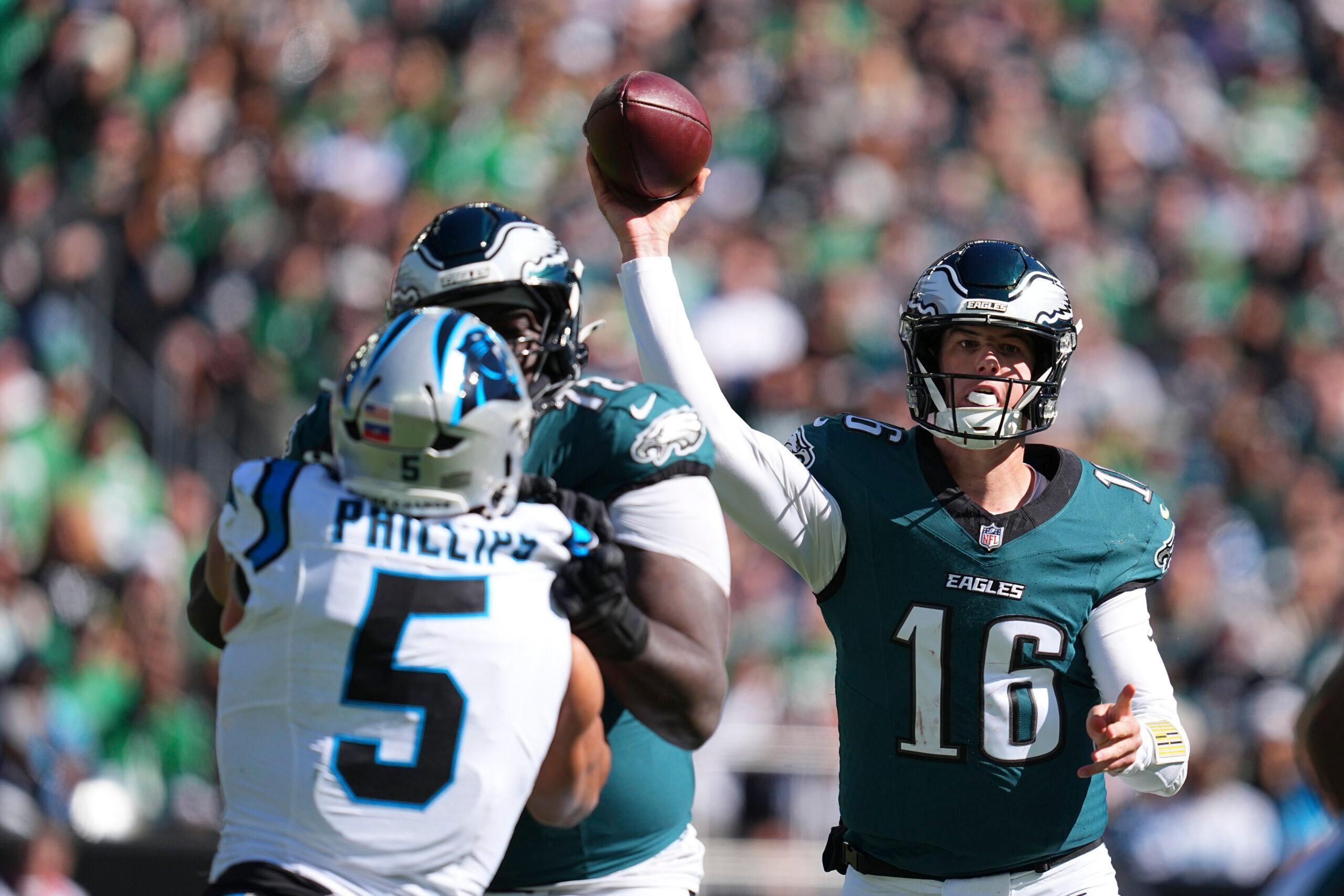
Four backup quarterbacks started Sunday, and all four lost. Tampa Bay Buccaneers rookie Jalon Daniels had a roller-coaster experience (again) in his third career start, with typical rookie lows and shocking highs. But Daniels, who is only starting because he beat out three-year veteran Jake Browning for the no. 2 job and Baker Mayfield suffered a thumb injury in Week 3, is playing better than anyone could have expected. The Tampa Bay offense sucked with Mayfield at the helm, and Daniels isn’t doing much worse. Daniels dropped back almost 50 times in a 26-19 overtime loss to the Steelers because the Bucs can’t run the ball; Tampa ranks 26th in success rate handing the ball off through six weeks.
Daniels was never going to fix his team’s offense, and neither was Philadelphia QB Tanner McKee, who started for the Eagles on Sunday as Jalen Hurts is being treated for blood clots. McKee, a 2023 sixth-round pick from Stanford who made his third career start on Sunday, also dropped back almost 50 times in a 25-14 loss, and no one should be surprised by that result. But the two other backups who started Sunday, Baltimore’s Tyler Huntley and the Giants’ Jameis Winston, had higher expectations.
Baltimore was a 3.5-point favorite on the road against the Browns, yet they lost 13-10 in an ugly outing. Cleveland honed in on stopping running back Derrick Henry and managed to hold him to just 58 rushing yards on 17 carries. That put too much emphasis on Huntley to create offense, and he just couldn’t do it. Henry losing a fumble in the fourth quarter that led to seven Browns points was just icing on the cake on a bad day for the Ravens offense. But despite Huntley’s lacking performance, Winston was the only backup that actually got benched for playing losing football.
Winston was benched during New York’s 34-27 loss to New Orleans after throwing his second interception in the fourth quarter. And in came J.J. McCarthy—formerly known as “Nine” and now “Nine 2.0” wearing no. 18 with the Giants—who nearly helped the Giants complete a 17-point comeback. McCarthy was a fun ride off the bench (he got an interception out of the way on his first possession, of course), but he’s not a solution. Neither is Winston. New Giants head coach John Harbaugh has weathered the storm after losing starting quarterback Jaxson Dart in Week 2, but the G-Men don’t have a good (healthy) quarterback on a very bad roster. Harbaugh can only do so much; expectations should be low for whatever Winston-McCarthy combination plays the rest of the way. —Austin Gayle
Loser: The Entire Colts Organization
If you replayed Sunday’s Colts-Titans game 100 times, the Colts would probably win a lot more often than not. The much-maligned Lou Anarumo defense held Cam Ward to 102 passing yards; Indianapolis’s offense had more than twice as many first downs and total yards as Tennessee; and the Colts nearly doubled the Titans’ time of possession. The Colts should have won this football game. Instead, they allowed a massive punt return, conceded a blocked-punt touchdown, and watched Daniel Jones throw two costly interceptions while in scoring territory. The 26-20 loss involved a stunning collapse for a team that led 13-0 at halftime, and it was a puzzling outcome for a franchise that has generally won the games it should win during Chris Ballard’s 10-year tenure as general manager.
It is dangerous to overreact to any one game in the NFL—especially one with as many outlier plays as this one. But given the growing anger in and around the Colts organization, this loss may be remembered as the final strike against the Ballard era.
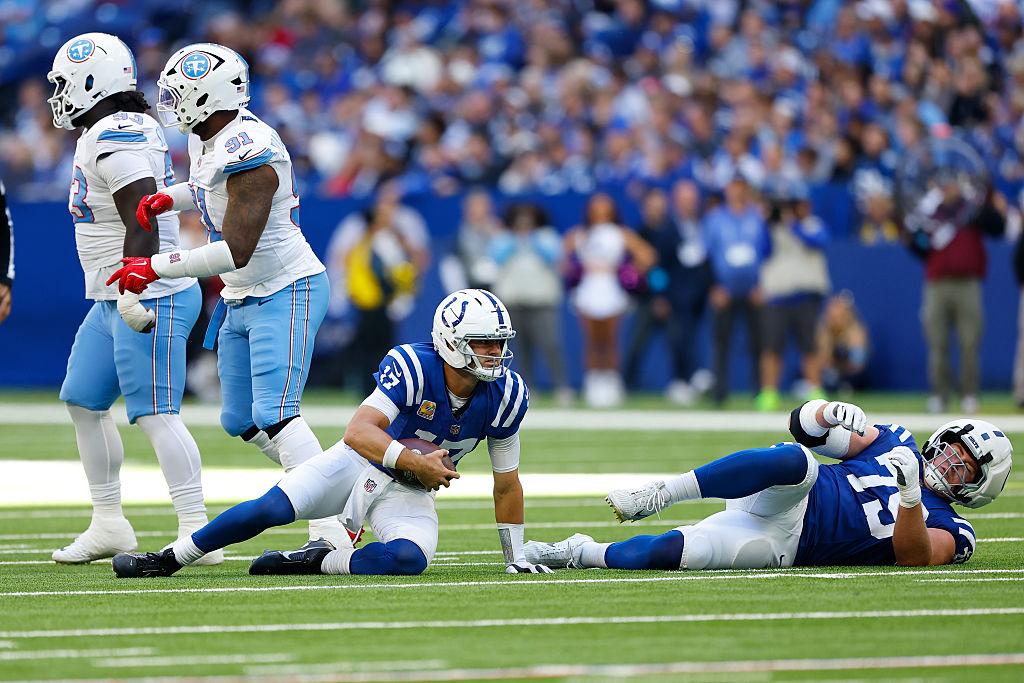
The Colts have won either eight or nine games in four of the last five seasons, so beating the winless Titans at home to move back to .500 felt like the natural order of things. Indianapolis has perfected one thing in the 2020s: sitting in the malaise of the AFC’s middle. But the roster entered this season dangerously thin, and injuries are now exposing holes all over it.
Sunday served as a microcosm of the roster-building problems that have been commonplace in recent Colts history. The absences of Ashton Dulin, Tyler Warren, and Alec Pierce left the Indy offense to feature longtime backup tight end Mo Alie-Cox, 34-year-old receiver Keenan Allen, and WR Laquon Treadwell, who as recently as last year was a practice-squad regular. Tight end Will Mallory—who had five catches over the previous two seasons entering Sunday—became a focal point of the passing game this week.
When Daniel Jones was healthy in the first half of last season, Indianapolis stunned opponents with its first-down efficiency and ridiculous explosive-play numbers. As time passes, that stretch looks more and more like the outlier. Jones has regressed massively under pressure this season. He’s making bad decisions, like the first-quarter throw in the red zone that led to his first interception of the game. His second-half interception came on first-and-10 at the Tennessee 24-yard line, a telegraphed throw directly to Cor’Dale Flott. Jones has fumbled four times and thrown six interceptions in six games. This is the quarterback Ballard and head coach Shane Steichen made a multi-year commitment to before the season. The depleted supporting cast and Jones’s limitations are now compounding each other and creating an offensive mess.
Carlie Irsay-Gordon took over as the franchise’s primary owner at the start of last season. It’s easy to see why she gave the current leadership another chance, given how much potential the team showed in the first half of 2025 before Jones’s injury. But Irsay-Gordon made clear that this was a playoffs-or-bust season. The Colts took one giant leap toward bust on Sunday afternoon. —Anthony Dabbundo
Winner: Caleb Williams
Williams is back healthy, and Chicago’s offense is a buzz saw again. The Bears beat the Falcons 31-23 on Sunday on the back of Williams’s excellent day: He completed 30 of 36 passes for 305 yards and a touchdown.
When Williams is dialed in, his game is scarily reminiscent of future Hall of Fame quarterback Aaron Rodgers in his athletic prime. Williams can throw accurately from every angle and slither past pressure no matter where it’s coming from. Atlanta’s had one of the league’s most productive pass rushing defenses this year—and it still racked up four sacks in the game—but it never felt like Williams was uncomfortable in the pocket despite this being his first game back from a hamstring injury.
Head coach Ben Johnson has to be ecstatic about Williams’s command over Chicago’s offense. Williams’s 73 percent completion rate both leads the league and meets the goal Johnson set for the QB to start the season. Since 2022, only four quarterbacks have a higher completion percentage through the first six weeks of the season, and it’s a huge leap from Williams’s 62 percent over the same span last year.
One of the biggest drivers of Williams’s success is his accuracy on underneath throws. Williams has completed 54 of 60 throws of 10 or fewer air yards this year, and he connected on 25 of 26 in Sunday’s action. His only miss would have been a touchdown if tight end Colston Loveland hadn’t run himself out of bounds. Williams is taking dump-offs when they’re available and trusting his receivers to create offense after the catch instead of relying so heavily on deep throws or his own scrambling ability.
He’s also been excellent when kept clean in the pocket. He completed 24 of his 25 unpressured pass attempts against the Falcons and has completed 85 percent of those throws so far this year. He’s seeing coverages and identifying matchup advantages very well, and he’s making the most out of his opportunities.
Since he’s started in only half of Chicago’s games so far, I’ll refrain from revving up the hype train too much—yet. But outside of a tough first half against the Vikings, we’ve been watching an MVP-level quarterback in Chicago, and he’ll certainly end up in the conversation if he can stay healthy and maintain this level of performance. —Lee
Loser: The Rams’ Special Teams (Forever and Always)
Somehow, amid all the fuck-them-picks, let’s-build-a-superteam bargaining the Rams have done with the football gods during Sean McVay’s decade in L.A., they wound up with the league’s most cursed special teams unit. That can be the only explanation at this point, right? We’ll let you have Matthew Stafford, but you’ll never have a reliable kicker, the gods must have said. Aaron Donald will come out of retirement, but every punt return will be an adventure.
The Rams’ special teams unit is a week-to-week punch line. Just a complete comedy of errors at this point. Six days after losing to the Bills on Monday Night Football because of a blocked field goal (that probably would have sailed wide anyway), and five days after cutting the Thicker Kicker (Harrison Mevis) and signing a svelte kicker (Blake Grupe), the Rams lost that new kicker to an injury when he tried to make a tackle on a kickoff return. The Rams then lost the game to the Cardinals 18-16. It’s ironic, probably, that the Cardinals won the game without scoring a touchdown; they just needed six field goals from their stalwart kicker, Chad Ryland.
Playing most of the game without a kicker meant that punter Ethan Evans had to handle kickoffs and that the Rams offense needed to go for two after their first touchdown (and they failed, hilariously so). When the Rams later had Evans attempt a PAT in the fourth quarter, backup QB Stetson had to enter the game as the new holder, and everyone at SoFi Stadium was probably holding their breath—even as the ball slipped between the uprights.
The Rams rank last in total special teams EPA through Week 6—there’s such a massive gap between the Rams at no. 32 and the 49ers at no. 29 that even if San Francisco melts down on every kick return and field goal attempt on Monday night, it’s unlikely they’ll catch up to the Rams when it comes to special teams ineptitude.
Special teams has been the Achilles’ heel of just about every McVay team. The Rams are last in special teams EPA since 2020 and have finished 30th or lower four times since then. They are well on their way to being not just last in the league in 2026 but one of the worst special teams units since 2000. They are averaging about six EPA lost on all special teams plays (kickoff and punt returns, field goal attempts, extra points, and two-point conversions). Of the 862 team seasons in the TruMedia database, the 2026 Rams rank 799th in special teams EPA. And if they continue at their current rate, they’ll become one of only two teams this quarter century to lose more than 100 EPA on special teams. (The 2000 Bills are last, with minus-109.45!)
And it’s not like this isn’t an acknowledged problem! This offseason, the Rams invested heavily in trying to fix what was the league’s second-worst special teams unit in 2025. McVay fired his ST coordinator before last season was even over and brought in Bubba Ventrone, a widely respected special teams coach who excelled as a ’teamer when he played in New England and as a young coach in Cleveland. The team signed a veteran long snapper, Joe Cardona, and linebacker Grant Stuard, a special teams coverage ace from Detroit. And yet the Rams continue to find new and increasingly embarrassing ways to lose games on special teams. They’ve now lost because of a kicker and because they’ve been without one. What fresh hell will the football gods inflict on the Rams next week? —Jones
Loser: Matthew Stafford
Breaking: A 38-year-old quarterback looked old as hell this week.
Snark aside, Stafford just didn’t seem to have the same pop in his arm during Sunday’s 18-16 loss to the Cardinals. And before the Rams’ mad dash to try to win the game in the fourth quarter, he was having an objectively bad outing. Stafford’s explosive pass rate (just under 3 percent) and average air yards (4.9) are bottom-five performances in his six-year tenure with the Rams. He couldn’t find anything open downfield, didn’t react well to pressure, and struggled to sustain drives when his offense needed him on third downs.
I don’t know whether all of that was an issue of general age or overuse, but I do know that Stafford’s 166 dropbacks in the three games prior couldn’t have helped. Stafford has taken 255 dropbacks so far this year, which is more than he’s ever had through six weeks of a season. Setting career-high usage numbers nearly two decades into a professional career feels suboptimal, and I don’t think anyone would’ve guessed that Stafford would be asked to use his arm like prime Randy Johnson—especially for a 2-4 team.
We saw him dial up his best play against the Bills last week, and I don’t doubt that he’ll meet our lofty expectations again this season. But the rough play against the 49ers, Broncos, and Eagles signals something that we (and head coach Sean McVay) need to take heed of: He’s just not that guy right now, and he might not be that guy ever again. His accuracy isn’t always there, and his reaction to pressure has worsened. Arizona blitzed Stafford relentlessly, and his play suffered as a result.
Just last week, I was still proudly planting my flag that the Rams would be fine, and that the people most adamant they would stumble would come back in a month ready to proclaim them as this season’s championship front-runners. Now, I’m devastated to admit that the haters have been absolutely right. The Rams need to find a way to win that doesn’t require Stafford to carry the team on his back, or this dream team will end up a letdown. —Lee
Winner: The NFL’s Most Reliable Offense
Buffalo doesn’t often get mentioned among the NFL’s worst defenses, but through six games, the Bills have been as bad as almost anyone. Only the Lions are allowing a worse EPA per drive, and the reason Buffalo’s defensive issues have been overlooked nationally is simple: The Bills keep winning. They’re 5-1, while the Lions and Cowboys, with similarly awful defenses, have six combined losses.
The Bills offense has to play nearly perfect football to win each week, and it delivered again in the second of its back-to-back road games on the West Coast. Buffalo scored on seven of its nine full offensive drives in a 33-30 win against the upstart Raiders. The defense remains a liability, but the offense continues to be a supernova.
Buffalo was tied for the fifth-highest explosive play rate of any offense through the first five weeks of the season since 2000. And Sunday showed that the Bills can also keep moving the chains when the big plays aren’t coming. Buffalo was methodical. Dalton Kincaid caught seven passes for just 38 yards, while James Cook supplied 95 rushing yards and another 58 through the air. The Bills kept coming back to the underneath throws and the running game because the Raiders couldn’t stop either consistently.
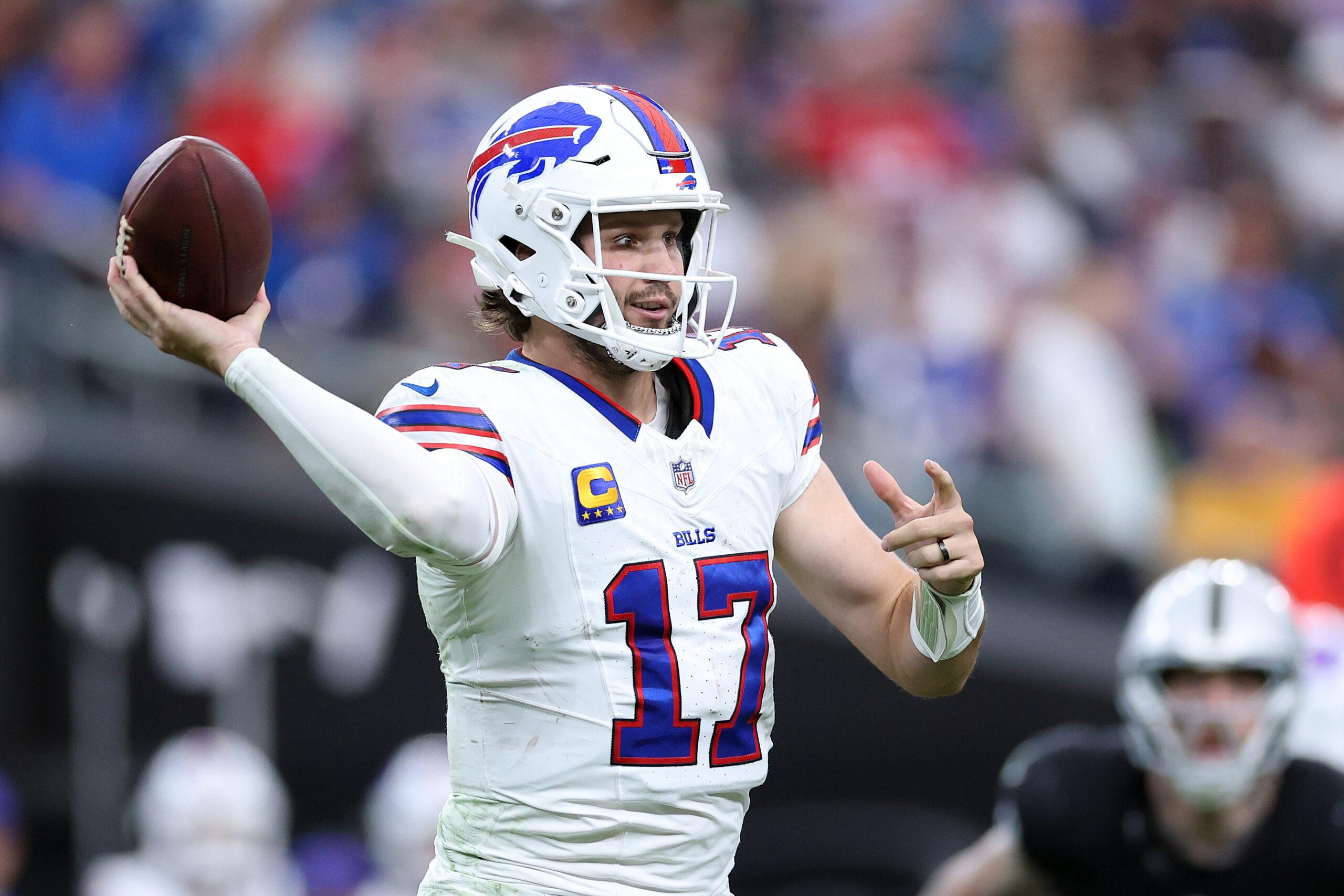
When Las Vegas tied the game at 23 with just over eight minutes remaining, Buffalo responded with a 66-yard touchdown drive. Cook accounted for 46 of those yards and finished the drive with a 3-yard touchdown run. On the next possession, a 15-yard completion to Keon Coleman helped Buffalo drain the clock and set up the field goal that pushed the lead to 10 and iced the game.
As long as Josh Allen is on the field, there is no more reliably elite offense in the NFL. And Allen alone can be a football magic factory. Facing third-and-8 from the Raiders’ 12-yard line, Allen stepped up into a collapsing pocket, drew defenders toward him, and somehow flipped a backhanded shovel pass to Coleman in the end zone.
It’s a play that only he, and maybe Patrick Mahomes, would even consider trying. Buffalo can beat you with the routine plays all afternoon, and when those finally break down, Allen can still do something like that. —Dabbundo
Winner: Us Laughing With Jim Nantz
Nantz, a veteran broadcaster of over 40 years, did something in the booth on Sunday that I’ve never seen him or any other football announcer do. J.J. Watt, Hall of Fame defensive lineman and Nantz’s new partner in the booth after the Tony Romo fallout, asked Nantz to throw a peanut punch while Watt showed the audience a picture-perfect technique for protecting the football. “Really?” Nantz asked, just before getting out of his seat, cocking his arm back, and firing his fist into the football. The football (and everyone watching) won.
Nantz, 67, probably threw his last IRL punch a long time ago, and maybe his last peanut punch on Sunday. He laughed after making contact with the football but rubbed his wrist as he sat back down. And later in the game, Nantz was seen with a wrap around his hand, which is a bummer. Sure. But Nantz is where he is now because it’s always been that easy for him to shock us to our core, with things we’ve seen a million times before or for the first (and last) time in one split second. It isn’t interesting that a guy in his 60s hurt his hand throwing a punch at a former NFL player in his 30s. It’s interesting that living legends had fun fooling around with a football in reckless, childlike wonder. We don’t see that enough from men in suits on TV. Thankfully, Nantz doesn’t pull punches. —Gayle